Act I  ·  1846 – 1858

The charter's long journey west.

Before there was a lodge in Centralia, there was a document — passed hand to hand across a continent, carried in a tin cylinder and then a rawhide trunk, by men who had never met, toward a territory that wasn't yet a state.

Scroll to follow
1846
Oregon City · Oregon Territory
The petition
A meeting was called for on February 21, 1846 to be held in the City Hall in Oregon City. It was attended by seven Masons. The purpose was to attempt to draw up a petition to obtain a charter. After some discussion, a petition was drawn up appealing to the Grand Lodge of Missouri for a charter for a Masonic Lodge at Oregon City, Oregon Territory, to be known as Multnomah Lodge.
1846
Platts City · Missouri
First handoff — Jack Palmer
William F. Dougherty entrusted this document to Jack Palmer who had arrived with a migration and was returning to Missouri to guide another migration train westward in 1847 to be delivered to Brother James A. Spratt of Platts City, Missouri. Jack Palmer delivered the document to Brother Spratt in the summer of 1846. Platts City Lodge #56 presented the petition to the Grand Lodge of Missouri session on October 17, 1846. The charter was dated October 18, 1846, lodge being named Multnomah Lodge #84, located in Oregon City, Oregon Territory. The charter was delivered to Brother Spratt.
Charter issued: Multnomah Lodge #84 · Oregon City, Oregon Territory
1847–48
St. Joseph · Missouri
Second handoff — Pierre B. Cornwall
A year passed and in December of 1847, Pierre B. Cornwall appeared in St. Joseph, Missouri, organizing a party for a trip to Oregon. Cornwall, being a Mason, Spratt entrusted him with the charter. Cornwall, with his brother, Arthur, a boy of 16 years of age, and Tom Fallen, a guide, left St. Joseph around April 1, 1848.
In transit: enclosed in a tin cylinder
1848
Council Bluff · Iowa
The Kelloggs
They traveled to Council Bluff, Iowa and found a large party from Ohio waiting for spring; but being anxious to be on their way, they joined a party of two brothers named Hathaway and a father and son, Orrin, and Joseph Kellogg; left Council Bluff, Cornwall having possession of the charter enclosed in a tin cylinder, and he learned that Kelloggs were Masons.
1848
Fort Hall · Present-day Pocatello, Idaho
Third handoff — the fork
The party reached Fort Hall, the present site of Pocatello, Idaho. Gold was discovered in California and this caused Cornwall to change his mind. His brother, Arthur, the guide, and he decided to go to California. The charter was given to the Kelloggs, who deposited the charter in a small brown haired raw hide trunk for the remainder of the journey westward.
Carrier: Kellogg family · vessel: small brown rawhide trunk
Cornwall & brother go to California.
road not taken
1848
Oregon City · Oregon
Delivered — two and a half years later
They reached Oregon City, Oregon on September 11, 1848. It was delivered to Joseph Hull, two and a half years elapsing since the petition was first drawn up. This small trunk is on display in a showcase in the Replica Room of Olympia #1, adjoining their present lodge.
The rawhide trunk · on display, Replica Room, Olympia Lodge #1
1851
Oregon · Grand Lodge formed
A grand lodge forms
On September 13, 1851, Willamette Lodge #11 and Lafayette Lodge #15 chartered from California, and met with Multnomah Lodge #84 of Oregon City, and formed the Grand Lodge of Oregon.
1858
Astoria · Oregon
Washington's turn
In 1858, Olympia Lodge #5 and Steilacoom Lodge #8 were represented at the Grand Lodge of Oregon; convened at Astoria where charters were granted to Grand Mound Lodge #21 and Washington Lodge #22 at Vancouver. Grand Mound Lodge #3 never prospered due to the rural location, and moved their charter to Tumwater in 1867, and becoming involved with Olympia #1, they surrendered their charter in 1869.
1858
Olympia · Washington Territory
The Grand Lodge of Washington
These four lodges mentioned met at the Masonic Temple at Olympia on December 6, 1858 and formed the Grand Lodge of Washington. The Grand Lodge of Washington returns for the following year showed the following membership of the four lodges to consist of 114 Master Masons, two Fellow Crafts and six Entered Apprentices.
122
Masons · Grand Lodge of Washington · 1858
114 Master Masons
2 Fellow Crafts
6 Entered Apprentices
Next
Centralia →
1846 → 1858
II
Act II  ·  1875 – 1922

A town is platted. Thirteen men meet above a meat market.

The Grand Lodge of Washington existed for seventeen years before anyone in Centralia thought to form a lodge. When they did, they started with twenty-eight dollars and tin jewels.

1875
Centralia, Washington · 218 North Pearl Street
1875
The city arrives
The City of Centralia was platted in 1875 and was first known as Cochran Prairie and changed to Centerville by George Washington, a Negro foster son of James and Anna Cochran who arrived in the area in 1852. David Fouts, who later became a charter member of Centralia Lodge, suggested the name of Centralia after his home town in Illinois. As there was another Centerville in the Washington Territory, this change was to avoid a conflict.
1872–89
The railroad comes
The Northern Pacific Railway came into Centralia in 1872, building their railroad from Kalama, Washington to Tacoma, and in 1872, the population of Centralia was 50. In 1874, the population was 200 and in 1889, it was 900. John T. Shelton, who also became a charter member of Centralia Lodge #63, married Angeline Waunch, she being the first white child born north of the Columbia River, and she lived on Fords Prairie.
1889
The petition
There was a number of Masons living in Centralia, and they decided to form a lodge, and after several meetings held in a building upstairs, later known as the Ideal Bakery building located at now known as Pine and Tower. The outcome of this meeting was a petition to William A. Fairweather, then Grand Master, for a dispensation. The petition was signed by W.H. Bachtell, Daniel B. Reese, Eugene A. Moore, Attra P. Ross, James Agnew, John B. McDonald, John M. Benedict, David Fouts, William C. Bennett, Joseph M. Lewis, Squire A. Sears, Henry S. Ogden, John T. Shelton, John Peel, George H. Ellsbury, and Henry J. Miller. The petition was granted by the Grand Master on December 30, 1889 in Ellensburg, Washington.
16 founding signatories · petition granted December 30, 1889 · Ellensburg, Washington
Jan. 11, 1890
First meeting
The first meeting was held on the 11th of January, 1890 in a hall over the Hoss Meat Market on the South East corner of Pine and Tower, now a parking lot. There were 13 Masons present at that time. H.J. Miller was appointed Treasurer; A. P. Ross, Secretary; John M. Benedict, Senior Deacon; David Fouts, Junior Deacon; and John Peel, Tyler. Saturday was voted as the regular meeting night, and the second and fourth Saturdays were scheduled. The jewels were made of tin by Brother Soldenstall until proper jewels and aprons could be ordered.
Treasury: $28.00 · dues: $3.00 per year · fee: $10 per degree
June 1890
Charter granted
The charter was granted on June 12, 1890 at the Grand Lodge Sessions being held in Ellensburg, Washington on February 8, 1890. By-laws were adopted; rent was established at $10 a month; lights and fuel furnished. Centralia Lodge #63 installed their officers on June 28, 1890 with 30 members present. Installed were: W.H. Bachtell, Worshipful Master; Daniel B. Reese, Senior Warden; Eugene E. Moore, Junior Warden; Attra B. Ross, Secretary; John Benedict, Senior Deacon; David Fouts, Junior Deacon; John Peel, Tyler; and Henry J. Miller, Treasurer.
Charter granted June 12, 1890 · 30 members present at installation · June 28, 1890
1892
A new hall
On March 12, 1892, Brother Joe Robinson stated he would build a new lodge hall providing the lodge would pay $30 a month. The lodge settled for $25, and on September 10, 1892, the lodge moved into their new home, located at, what is now known as 109 North Tower, known as Pippins Book Store, and which is now occupied by a glass-repair firm. On January 8, 1892, Centralia Lodge #63 granted a petition to form Tenino Lodge #86. The lodge finances were always low, and it was necessary to borrow money to pay their per capita tax. On November 12, 1892, dues were raised to $5 a year.
1902–09
Small gifts, lasting things
On May 10, 1902, a third degree was conferred on R.L. Sebastian, who was our Grand Master in 1915. On February 4, 1905, Brother H.W. Thompson presented the lodge with a rough and perfect ashlar, still in use, the gift of Brother W.W. Ingalls. On April 15, 1905, Brother H.W. Thompson, on behalf of R.L. Sebastian and Brother A.P. Hayes, presented Brother W.O. Bennett with a fob and charm, a token of their appreciation of his true Masonic character and untiring efforts towards Masonry. On January 2, 1909, iron rod bases for the stewards and deacons were presented to the lodge by Brother H.E. Lockwood who was employed by the Symons Foundry, and they are still in use.
The ashlar · still in use · the jewel · on display in the lodge lobby
1910
Memorial Day begins
Worshipful Brother John Benedict, Jr., Master in 1910, started decorating the Masons' graves with a Masonic emblem on Memorial Day. He continued alone for a number of years, but as the job grew larger, he appealed to the lodge for help. The lodge has continued this project and currently four cemeteries are decorated each year.
1912
The building fund
On January 1, 1912, a building fund was established with $100 and $25 from each petition to be placed in a special fund, and Brother J.M. Benedict was appointed trustee of the fund; and the by-laws were so changed and approved. The building trustees appointed consisted of C. Paul Uhlmann, W.H. Gaylord and C.L. Rickard, along with the members of Lodge #63, F. & A. M. At the time of planning for a new temple building, there was the task of raising funds. The lodge was prospering during this period. An architect was selected to meet with the building committee, and the selection was Dennis Nichols of the Blurock Building in Vancouver, Washington.
Architect: Dennis Nichols · Blurock Building, Vancouver, Washington
July 21, 1919  ·  The gift

The Shriners donate the land.

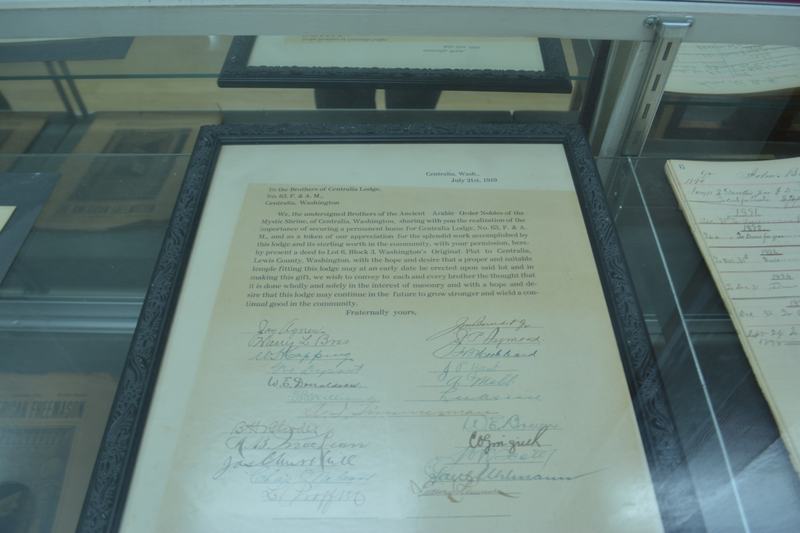
On July 21, 1919, Brother Paul Uhlmann presented a proposition to the lodge from the Shriners to present a site if immediate steps were taken to erect a building thereon. The offer was accepted at a special meeting on July 25th on condition that $20,000 in non-interest bearing bonds be sold. Brothers Uhlmann, Gaylord, Johnston, Keir and Noel were appointed as a committee to raise the necessary funds. This committee reported on October 20th that $20,000 had been raised and as much more was in sight.

Centralia, Wash. · July 21st, 1919 · To the Brothers of Centralia Lodge No. 63, F. & A. M.
1919 letter from the Shriners donating land to Centralia Lodge No. 63
High-resolution scan pending · interactive annotations forthcoming
$75k
Planned cost
of construction
$67,440
Contracts signed
April 17, 1920
$20k
Bonds raised
in weeks
1922
Cornerstone laid
July 8
Walter Stephenson, General Contractor · $53,716
J. Frieslieben, Heating $5,889  ·  Devere Electrical $1,634  ·  Modern Plumbing $3,000  ·  Architect's fees $3,211.45
1922
July 8, 1922

The cornerstone is laid.

The cornerstone was laid on July 8, 1922 by James McCormick, Grand Master, and dedicated on April 7, 1923 by Grand Master James McCormick.

Laid by the M.W. Grand Lodge
of F.&A.M. of Washington
July 7 · A.L. 5922
Grand Master James McCormack
1923
April 7 · dedicated

The building that stands at 218 North Pearl Street today is the same building dedicated in 1923. The shaft built for an elevator that the lodge could never afford. The bonds that came due during the Depression and were never paid. The building endured both.

III
Act III  ·  1923 – 1990

The building endures. The bonds are never paid. The lodge carries on.

Through the Depression, through decades of quiet service, through an elevator salvaged from a building someone else was tearing down — the lodge continued.

1926
A change of schedule
In 1926, the date was changed to the third Monday. In 1911, the lodge had changed the meeting days from second and fourth Saturdays to the first and third Mondays. In 1948, December 27th was included for the installation of officers. However, due to the cause of unable to install the Master on that evening for unforeseeable reason, it was taken out of our by-laws in 1976, and at the same time, our dues were raised from $10 to $15 a year.
Centralia lodge #63 was again plagued with financial trouble on two different occasions, and it was seriously considered to sell the building.
VW Clayton Lavigne · Centennial Committee, 1990
1930s
The Depression
During the depression of the 1930's, the lodge not only lost members and income, but was unable to payoff the building bonds that were coming due. W. Brother Paul Peyton, Chairman of the Building Trustees, presented a plan, and it was agreed upon by the bond holders to defer payment on the bonds. This plan led to the dissolving of the debt and the bonds were never paid.
Early 1950s
The elevator
The lodge building plans had a shaft for an elevator, but the lodge had never been able to afford this luxury. In the early 1950's, the lodge was again discussing the possibility of installing an elevator. W. Brother Paul Peyton, through his connection with builders and contractors, knew that a good elevator was being removed from the Weyerhaeuser Building in Tacoma before demolition. W. Brother Peyton presented the plan to the lodge, and after discussion, the lodge authorized W. Brother Peyton to purchase the elevator, and a local contractor was chosen to install the elevator in 1956.
Installed 1956 · salvaged from the Weyerhaeuser Building, Tacoma
Kitchen renovation
Brotherhood at work
The lodge decided to remove the old stage in the dining room that was never used and enlarge the kitchen to better use the space. The work was spearheaded by W. Brother Earl Gullickson, assisted by many dedicated and hard working brothers who furnished labor and material.
1962
The scholarship
The Grand Lodge in 1962 requested all lodges to enter into a scholarship program. The Worshipful Master appointed a committee, and the George Washington Good Citizenship Program was organized and has grown into a very good annual program in Centralia High School. It currently offers a $500 scholarship at the college of the winner's choice, backed by the scholarship endowment fund, supported by Centralia Lodge.
$500 scholarship · George Washington Good Citizenship Program · Centralia High School
1964
Incorporation
The temple was incorporated 1964; the Articles of Incorporation were drawn up by the trustees with the consent of the lodge by Brothers Charles Dieckman, Lloyd Alleger and Joseph Daly; and were approved by the lodge and by the Grand Master, Raymond L. Peel. Those members signing were as follows: Brothers Chester L. Gibson, Worshipful Master; Arthur Andersen, Senior Warden; Howard Hense, Junior Warden; Hershall Waitt, Secretary; Clarence G. Hoerling, Treasurer; R. L. Alleger, Trustee; Charles L. Dieckman, Trustee; Joseph Daly, Trustee; James Benedict Past Master; and Frank Silvey, Past Master. We are on a permanent incorporated basis with the State of Washington, and at that time, the initial payment gave us a permanent status.
Incorporated 1964 · State of Washington · Grand Master Raymond L. Peel
1965 – 81
Temple board
A committee was appointed to study all rentals in the building consisting of Brothers Joseph Daly, Charles Dieckman, James Benedict, and R. L. Alleger. Joseph Daly was elected as President of the Temple Board on March 31, 1965; Lloyd Alleger, Secretary-Treasurer. Election on January 4, 1966 resulted in Joseph Daly as President, Arthur Andersen, Vice President, Lloyd Alleger, Secretary-Treasurer. Charles Dieckman resigned from the board. On January 3, 1967, Merret Hoard was elected to the temple board, a three year term; Worshipful Brother Ernie Kuper, elected President in 1971; Richard E. Nyholm, elected in 1976. On April 29th, Joseph Daly read a letter from the Grand Lodge in answer to Brother Daly's effort to borrow $10,000 at 5% interest, paying the loan off at $2,000 a year, plus interest, as the temple was again in a financial bind. This money was used to put the temple in good condition; installing a new roof, installing two new gas furnaces (as the old furnace was worn out), painting and waterproofing the outside south wall, as well as painting the interior of the south wall.
$10,000 at 5% · new roof · two new gas furnaces · south wall waterproofed and painted
1981
Board officers
Brother Joseph Daly was elected Secretary of the Temple Board in September, 1976 as Brother Lloyd Alleger resigned. In 1981, election of board officers were as follows: Worshipful Brother Ernie Kuper, President; Randy Roberson, Vice President; Richard E. Nyholm, Treasurer; and Joseph Daly, Secretary; and they are still serving on the board in those capacities.
A record of continuity
Four treasurers. One hundred years.
Centralia Lodge has had only four treasurers in its first century. The tenure of W.W. Dickerson — nearly half a century — has never been approached.
Henry J. Miller 1890 – 1892
2 yrs
W.W. Dickerson 1892 – 1941
49 yrs
Clarence G. Hoerling 1941 – 1964 · died in office
23 yrs
Joseph Daly elected 1985
1985 –
A longer line
The secretaries of Centralia Lodge No. 63
There was a good number of secretaries. Brother William O. Bennett served first, then twenty-three others whose names were not recorded in the centennial history — until Vance Noel, who served thirty years.
William O. Bennett 1890 – 1892
23 secretaries · 1892 – 1922 · names not recorded in the centennial history
Vance Noel 1922 – 1952  ·  30 years
Adelbert Convis 1953 – 1958
Hershall Waitt 1959 – 1967
William J. Johnson 1968 – 1969
Joseph Daly 1969 – 1984
V. Worshipful Brother Clarence Robbins 1985
Worshipful Brother Varden "Bud" Boergadine 1986 –
Five deputies appointed by the Grand Lodge
William W. Gaylord 1934
Clarence G. Hoerling 1946
Clarence Robbins 1961
Raymond Butler 1965
Richard E. Nyholm 1976
Grand Masters raised in Centralia Lodge
Robert L. Sebastian 1915 – 16
Frank Fulton 1958 – 59
Fulton served during the Grand Lodge Centennial year.

Centralia Lodge #63 is financially strong, and the temple is in excellent condition. We owe the members of the Temple Board a vote of thanks for the excellent job they have done in keeping a tight line on all activities.

VW Clayton Lavigne · Prepared for the Centennial, 1990
Est. 1890.
218 North Pearl Street  ·  Centralia, Washington